In this complete guide, based on verified experiences and up-to-date 2026 information, we will show you exactly what to expect, how to get there, what a true private tour includes, and why this experience will transform your understanding of the Maya civilization.
Why Is Chichén Itzá ONE of the 7 Wonders of the Modern World?
When we talk about Chichén Itzá, we are not talking about just any archaeological ruin. On July 7, 2007, more than 100 million people voted worldwide to choose Chichén Itzá as one of the New Seven Wonders of the Modern World.
But numbers do not tell the whole story. What makes Chichén Itzá special is its perfect fusion of architecture, astronomy, and cultural significance.
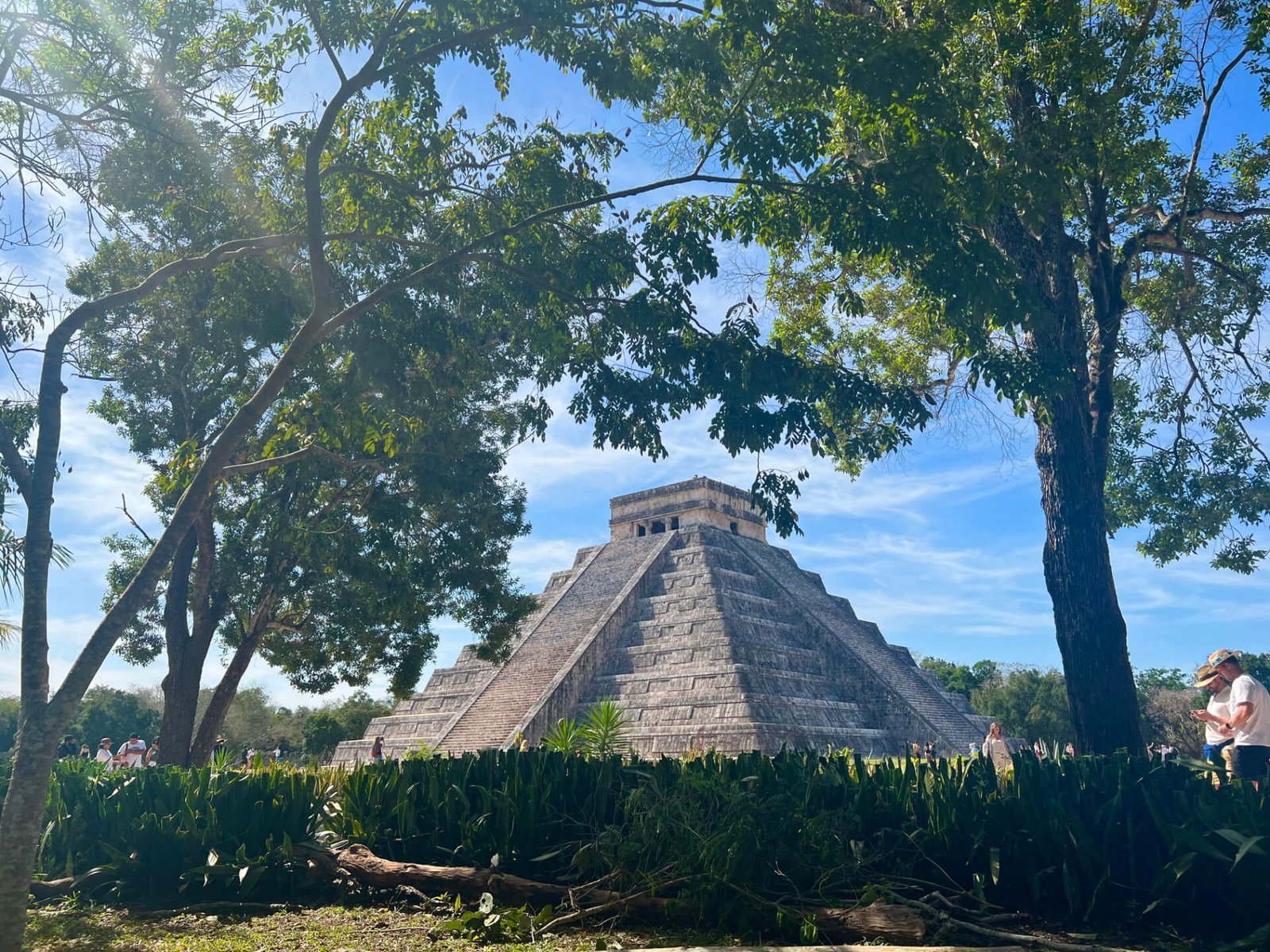
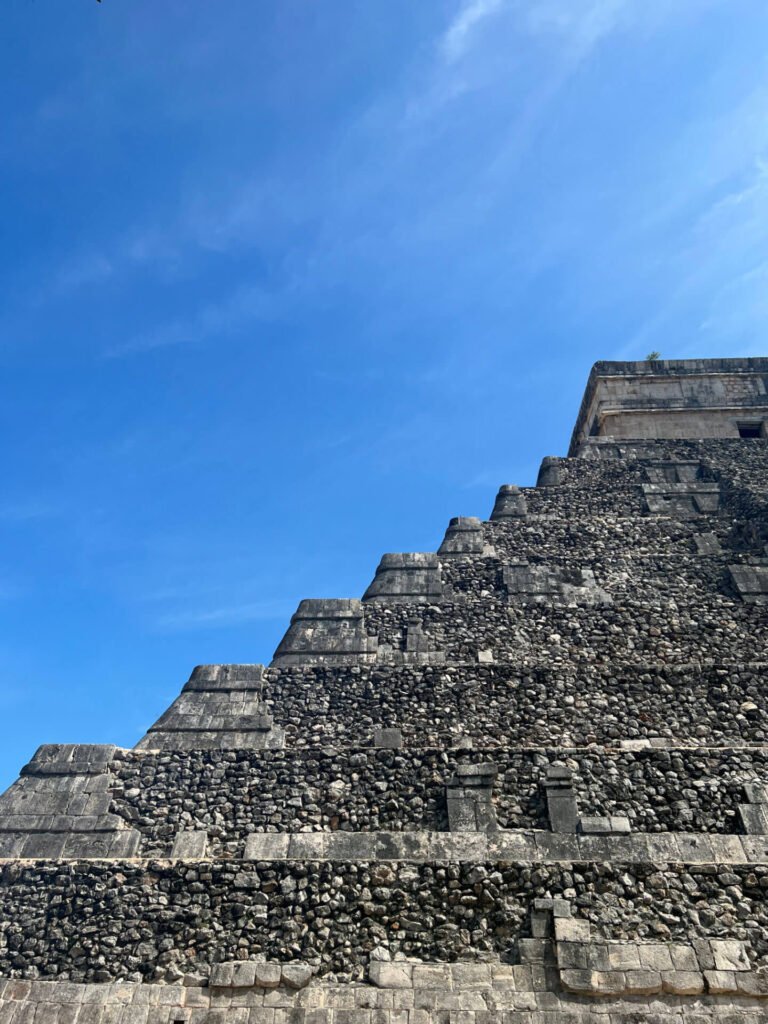
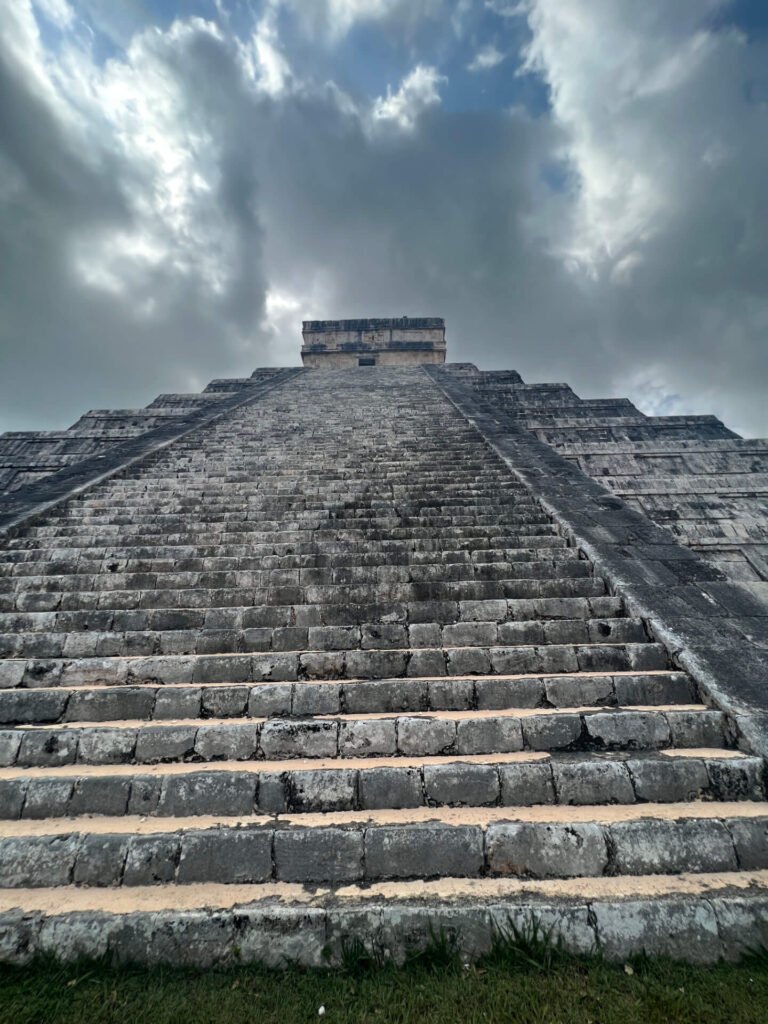
The Pyramid of Kukulkán, its most iconic structure, is not just beautiful—it is a living stone calendar. It has exactly 365 steps (including the top platform), representing the days of the Maya solar year. During the spring and autumn equinoxes, a unique astronomical phenomenon occurs: the shadow cast by the pyramid creates the illusion of a serpent descending the steps, connecting sky and earth in a symbolic act of worship to the god Kukulkán.
It was this combination of architectural genius, mathematical precision, and spiritual depth that led Chichén Itzá to be recognized as a UNESCO World Heritage Site in 1988, and later voted a world wonder.
Where Exactly Is Chichén Itzá? A Complete Geographic Guide
For travelers coming from anywhere in the Riviera Maya, it is important to understand the geography of how to get to Chichén Itzá. Chichén Itzá is not on the coast, but in the heart of the Yucatán Peninsula—specifically in the municipality of Tinum, in the state of Yucatán.
Distances from main points:
- From Cancún: 200 kilometers (2.5 to 3 hours by vehicle)
- From Playa del Carmen: 180 kilometers (2 to 2.5 hours)
- From Cozumel: Requires ferry + road (3.5–4 hours)
- From Tulum: 160 kilometers (2 to 2.5 hours)
- From Mérida: 120 kilometers (1.5 to 2 hours)
What many tourists do not know is that the Chichén Itzá area also serves as a gateway to other archaeological and natural gems. Valladolid, a colonial “Pueblo Mágico” founded in 1545, is only 45 minutes away, offering a fascinating perspective on Spanish colonial architecture blended with Maya influences. And along the way you will find sacred cenotes—natural freshwater sinkholes that the ancient Maya considered portals to the underworld (Xibalbá).
Complete Itinerary: Private Tour to Chichén Itzá (11–13 Hours of a Full Experience)
What Are Your Options for Getting to Chichén Itzá?
When planning your trip to the Riviera Maya, one key question is: How do I get to Chichén Itzá? You have four main options, each with distinct pros and cons.
Option 1: Private Tour with Transportation Included (RECOMMENDED)
A private tour with us is the most comfortable and complete option. We offer punctual pickup from your hotel in Cancún, Playa del Carmen, or anywhere in the Riviera Maya, with a professional driver who takes you directly to Chichén Itzá. It includes a certified bilingual guide (Spanish/English), admission to the archaeological site, a visit to a sacred cenote, a regional buffet meal with a drink, and a stop in Valladolid. The full trip lasts between 11 and 13 hours, depending on where you are staying.
Advantages:
- Worry-free pickup and return
- Expert guide who explains Maya history
- Cenote included (a must-do experience)
- Authentic regional meal
- Flexible schedule
Option 2: Rental Car (Maximum Freedom)
If you are looking for maximum freedom, you can rent a car at Cancún Airport. Mexican highways toward Yucatán are well maintained, and the trip is relatively straightforward. From Cancún or Playa del Carmen, you take Highway 180D, which is completely straight and safe. From Tulum, you can take Route 109 Coba–Chemax and then 180D.
Advantages:
- Total schedule freedom
- No dependence on tour groups
- Opportunity to visit secondary cenotes
- Admission cost + fuel
Disadvantages:
- No local guide (you miss historical context)
- Long-distance driving in tropical heat
- No meal included
- Navigation responsibility
Option 3: ADO Bus (Limited Budget)
The ADO bus is the most economical option. From Cancún, it costs approximately 350 Mexican pesos (about $20 USD) and takes 3.5 hours. The issue: it departs at 8:45 AM and returns at 4:30 PM, giving you only 2–3 hours at Chichén Itzá. Many travelers use this route only as transportation, pairing it with local guides they find at the entrance.
Advantages:
- Very low cost
- Directly to the entrance
Disadvantages:
- Limited schedules and little time
- No guide or additional services
- Traveling with strangers
- Impersonal experience
Option 4: Group Tour (Middle Ground)
Group tours operated by agencies such as Xcaret or Viator depart with 20–50 people, include a guide and meal, but you sacrifice privacy and flexibility. The cost is similar to the private tour ($200–240 USD/person), but you share the vehicle and guide with many tourists.
Our Recommendation: For most travelers, a private tour offers the best balance of comfort, authenticity, and value—especially if you are traveling as a couple or with family. You not only receive safe transportation, but also an educational and personalized experience.
What Is Really Inside Chichén Itzá? The Attractions You Must See
Many travelers arrive at Chichén Itzá expecting only “a big pyramid.” The reality is that Chichén Itzá is a 79-hectare archaeological complex with dozens of structures, each telling a different story about the Maya civilization.
The Pyramid of Kukulkán (El Castillo) – The Global Icon
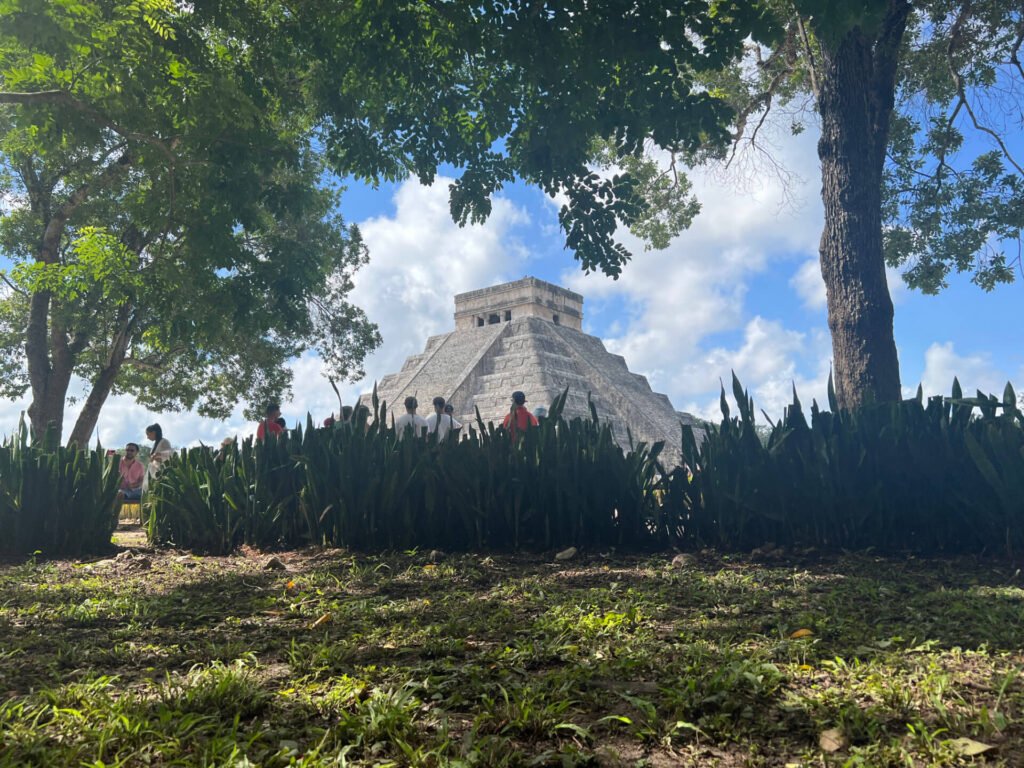
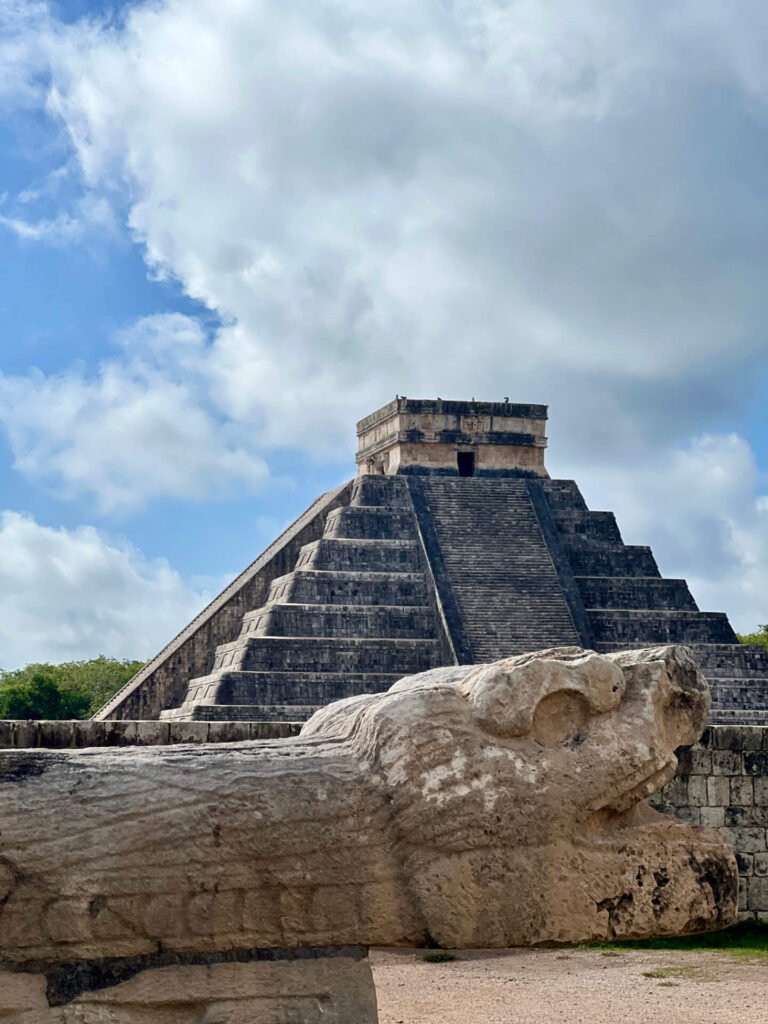
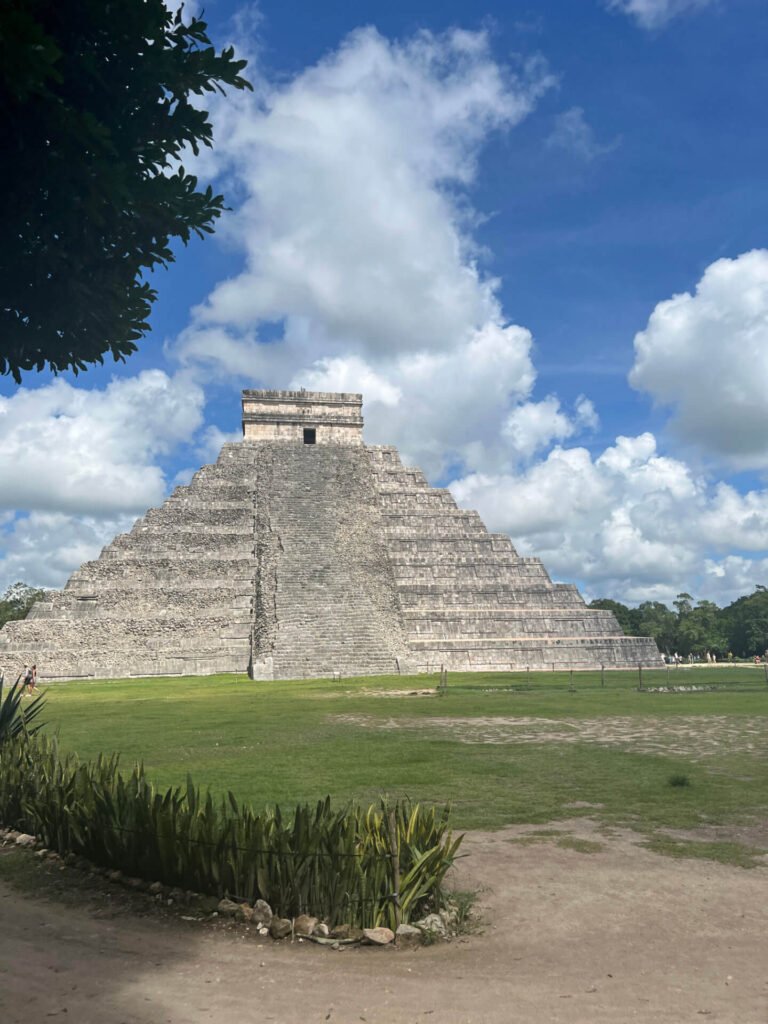
This is the first monument you see, and it is impossible not to be impressed. The Pyramid of Kukulkán, also known as “El Castillo,” is a 24-meter-tall structure built between 1050 and 1200 AD during the Maya Postclassic period.
Its brilliance lies in its 365 steps, which represent each day of the Maya solar calendar. But here is what is fascinating: you have not been able to climb the pyramid since 2006 for preservation reasons, but you will see thousands of tourists trying—so your guide will tell you exactly where and how it was done historically.
During the spring (March 21) and autumn (September 22) equinoxes, the sun’s movement creates a shadow that looks like a rippling serpent descending the steps—a perfect connection to Kukulkán, the Maya feathered serpent. If your trip coincides with these dates, it is a truly magical experience, although you should expect massive crowds.
The Great Ball Court – The Largest in Mesoamerica
Dimensions: 168 meters long by 70 meters wide. This is not a casual game—it is a ceremonial structure where the ball game was played, a ritual that blended sport, politics, and religion.
Archaeologists believe the losing team was sacrificed in honor of the gods. Walking around this enormous court, imagining thousands of years of rituals and history, is deeply impactful.
The Sacred Cenote (Cenote Xtoloc)
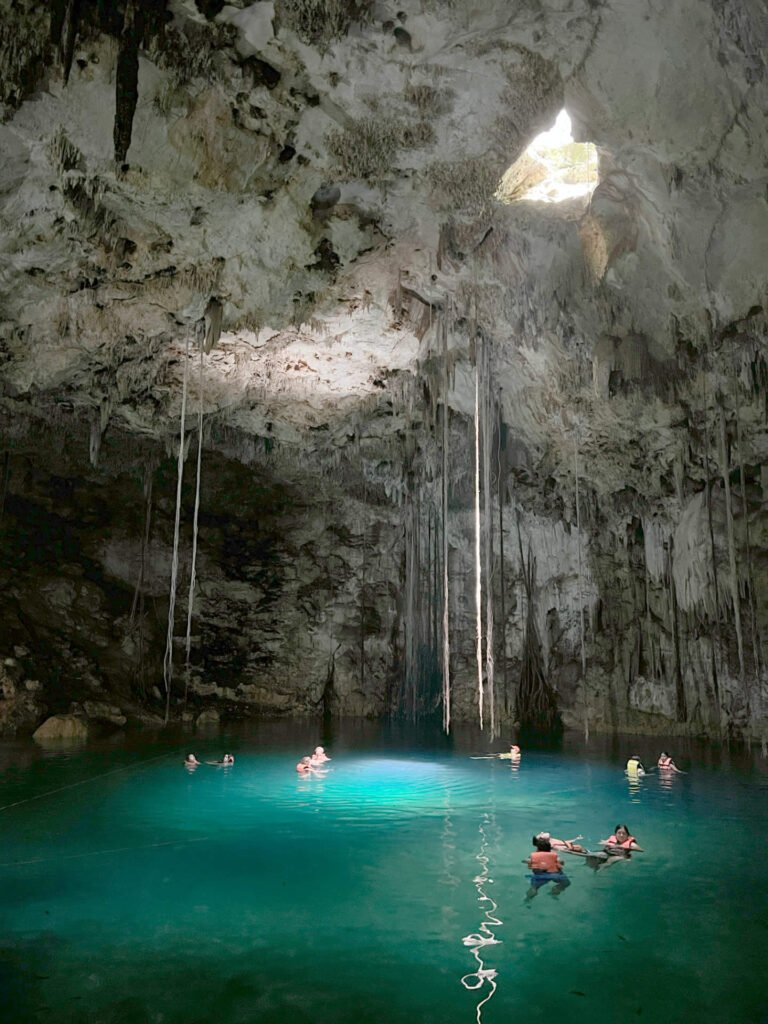
For the Maya, this was not a place for recreation—it was a sacred portal to the underworld. Archaeologists have found artifacts thousands of years old at the bottom of the cenote, including ceramics, obsidian, and bones, indicating that the Maya performed rituals and offerings here. During the private tour, you will visit a different cenote (usually Tsukán or Saamal, nearby but not the main site at Chichén Itzá) so you can swim safely and comfortably, recreating the Maya experience of immersing yourself in these sacred waters.
El Caracol (Observatory) – Astronomical Sophistication
This unique circular structure was built with precise alignments to Venus and the sun’s movement. The Maya, without telescopes or modern technology, observed the skies from buildings like this to keep accurate calendars and predict celestial events. Walking around El Caracol gives you an incredible perspective on how advanced Maya astronomy was.
The Temple of the Warriors
One of the best-preserved buildings in Chichén Itzá, the Temple of the Warriors is surrounded by hundreds of cylindrical columns (the “Group of a Thousand Columns”). These columns are carved to represent warriors in formation, reflecting the military importance of Chichén Itzá during its peak.
The Temple of the Bearded Man and Other Structures
There are more than 20 significant structures that your expert guide will point out during the 2.5-hour guided visit. Each has a story—from temples dedicated to Maya deities to residential structures for the elite.
Who Built the Pyramids of Chichén Itzá and WHEN?
A common question is: When was Chichén Itzá built? The answer is more complex than a single date, because Chichén Itzá was built and rebuilt over several periods.
Early period (600–900 AD): Chichén Itzá began as a small settlement during the Late Classic period of the Maya civilization, focused on agriculture and local trade.
Peak (1000–1200 AD): Between 1000 and 1200 AD, Chichén Itzá experienced a massive architectural renaissance. Researchers believe that a mix of local Maya and Toltec influences (a Nahuatl group from central Mexico) transformed Chichén Itzá into a regional political and religious power. It was during this period that the Pyramid of Kukulkán, the Temple of the Warriors, and the Great Ball Court were built.
Decline (1200–1500 AD): Around 1200 AD, Chichén Itzá was mysteriously abandoned. Archaeologists theorize about droughts, political conflicts, or changes in trade routes, but the exact reason remains an academic debate.
Rediscovery (1800s–present): After centuries of abandonment, Chichén Itzá was rediscovered by Spanish explorers in the 16th century and later was systematically explored and restored by archaeologists during the 20th century.
The builders were Maya, although later architectural influences (post-1000 AD) include Toltec elements from northern Mexico. They were not “aliens” or mysterious civilizations—they were incredibly sophisticated human engineers who understood mathematics, astronomy, and architecture at levels that rivaled the most advanced civilizations of the ancient world.
How Much Does It Cost to Visit Chichén Itzá in 2026?
The cost of your Chichén Itzá experience is divided into several components. It is important to understand exactly what is included to avoid surprises.
Admission to the Archaeological Site
Admission to Chichén Itzá varies depending on your nationality:
- Mexican citizens: $285 MXN (~$17 USD)
- Foreign tourists: $643 MXN (~$35–36 USD)
Tickets are valid for one day and give you unlimited access to all structures within the 79-hectare complex.
Complete Private Tour with Caribe Nut
A private tour to Chichén Itzá from Cancún or Playa del Carmen costs between $200 and $240 USD per person (or the equivalent in Mexican pesos, approximately $3,700–4,440 MXN). This includes:
- Round-trip transportation in a private, air-conditioned vehicle
- Admission to Chichén Itzá (already paid)
- Certified bilingual guide with expertise in Maya archaeology
- Visit to a sacred cenote with swimming equipment
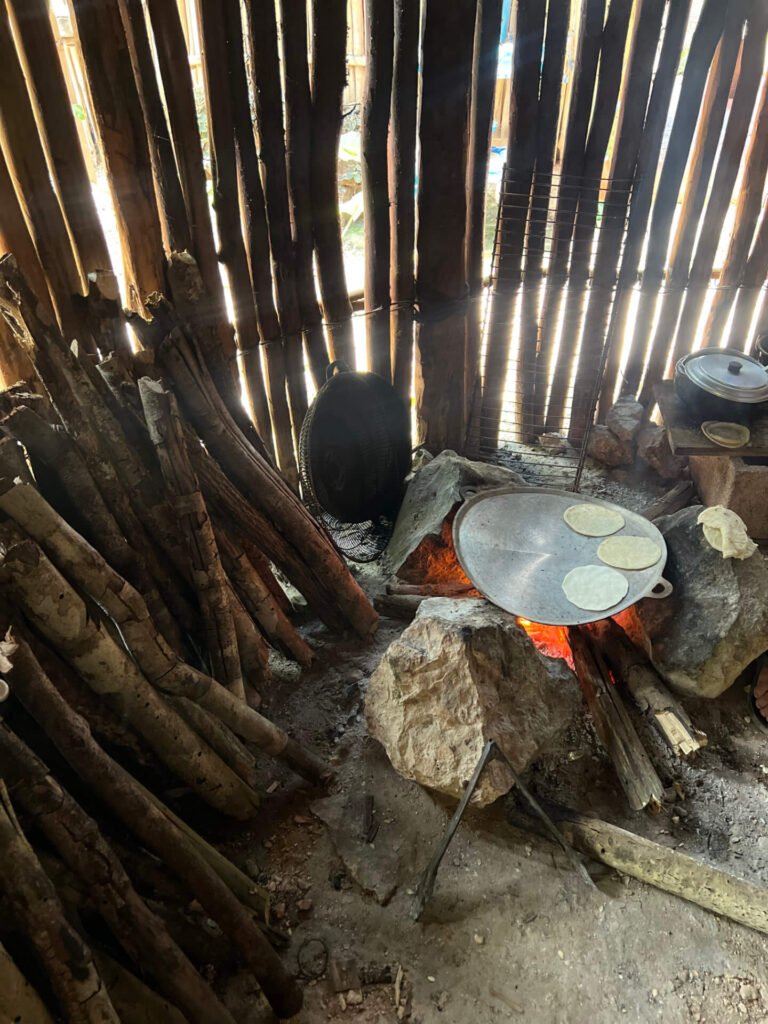
- Regional Yucatecan buffet meal + 1 drink
- Express visit to Valladolid (“Pueblo Mágico”)
- Sun-protection umbrellas
- Snacks and drinks on board the vehicle
- Complimentary hat
What is NOT included:
- Tips for the guide (recommended 10–15%)
- Personal purchases (souvenirs, professional-quality photos)
- Additional activities (cenote zip line, photos with a macaw, etc.)
Comparison of Total Costs
| Option | Total Cost (USD) | Time | Includes Guide | Includes Meal | Experience |
| Private Tour (Min. 4 People) | $160–200 | 11–13h | Yes, certified | Yes | Personalized |
| Group Tour | $120–150 | 11–13h | Yes, varies | Yes | Shared |
| Rental car | $80–100+ | Variable | No | No | Independent |
| ADO bus | $25–40 | 3.5h | No | No | Minimal |
For most travelers, the private tour offers the best value, considering that you receive comfort, education, safety, and a stress-free experience.
What Is the Best Time to Visit Chichén Itzá?
Although Chichén Itzá is open 365 days a year (8:00 AM to 5:00 PM), the best time depends on your preferences.
Best Overall Time: October to April
During these months, temperatures are more moderate (25–28°C / 77–82°F), humidity is lower, and rainfall is scarce. It is peak tourist season in the Riviera Maya, so expect more people and higher hotel prices.
Special Phenomenon: Equinoxes (March 21 and September 22)
On these days, the sun’s angle creates an optical illusion in which the pyramid’s shadow forms a rippling serpent descending the steps—a reference to the god Kukulkán. Thousands of tourists come specifically for this event. Expect extreme overcrowding (more than 10,000 people) and book months in advance.
Rainy Season: May to September
Although it is hotter and it rains regularly, these months have fewer tourists, which means quieter experiences and lower prices. Rain usually occurs in the afternoon, so you can visit in the morning.
Free Admission (For Mexicans)
Every Sunday, Mexican citizens enter Chichén Itzá for free. This means massive crowds. Unless you are Mexican and looking to save money, avoid visiting on Sundays.
How Many Hours Do You Really Need at Chichén Itzá?
Quick Visit: 1–2 Hours
If you only want the “main attractions” and Instagram photos, 1–2 hours is enough. You will see the Pyramid of Kukulkán, the Great Ball Court, and perhaps the Sacred Cenote.
Full Visit (RECOMMENDED): 3 Hours
With an expert guide, 3 hours allows you to explore 15–20 structures and understand Maya astronomy, architecture, and worldview. This is the standard on professional tours such as Caribe Nut.
Deep Immersion: 5–6 Hours
If you are passionate about history and archaeology, you can spend 6–8 hours exploring every corner, visiting multiple cenotes, and reading informational plaques. Some flexible private tours allow this.
Typical 11–13-hour tours include 3–4 hours at Chichén Itzá (after transportation, cenote, and meal), offering a perfect balance between Chichén Itzá and other experiences such as Valladolid and the cenotes.
Frequently Asked Questions: What Travelers REALLY Ask
u003cstrongu003eIs it safe to travel to Chichén Itzá from the Riviera Maya?u003c/strongu003e
Yes, completely safe. The Cancún–Playa del Carmen route to Chichén Itzá is one of the busiest highways in Mexico, well maintained and heavily used by tourists. Caribe Nut operates with certified drivers and insured vehicles. The archaeological site is monitored by Mexican authorities and is among the safest places in the country.
u003cstrongu003eWhat should I bring to Chichén Itzá?u003c/strongu003e
Essentials: Sunscreen (SPF 50+), cap or hat, sunglasses, reusable water bottleu003cbru003eFor the cenote: Swimsuit, towel, water shoesu003cbru003eFor comfort: Light, comfortable clothing (cotton), insect repellent if you are sensitiveu003cbru003eDocumentation: Passport or ID (although it is not required inside, it is a good idea)u003cbru003eMoney: Cash in Mexican pesos (there is limited change at the entrance)u003cbru003eCamera: Your smartphone is enough, but bring an extra battery or power banku003cbru003eThe private tour will provide umbrellas and additional protection, so you will be well covered.
u003cstrongu003eCan I climb the Pyramid of Kukulkán?u003c/strongu003e
Not since 2006. Climbing was prohibited to preserve the structure and for visitor safety. Many people have died falling from the pyramid (it is quite tall), so the ban makes sense. However, seeing the pyramid from every angle is almost just as impressive.
u003cstrongu003eWhat languages do the guides speak?u003c/strongu003e
Caribe Nut guides are certified bilingual in Spanish and English. Many also speak basic phrases in French and German. If you have special language needs, please mention it when booking.
u003cstrongu003eAre there vegetarian/vegan options in the included meal?u003c/strongu003e
Yes, the regional Yucatecan buffet includes vegetarian options (rice, beans, salads). Please mention dietary preferences when booking and accommodations will be made.
u003cstrongu003eCan I bring small children?u003c/strongu003e
Absolutely. Chichén Itzá is safe for children of all ages. Private transportation is perfect for families with children, as you control stops and pace. Please note that you will walk 2–4 km on a hot day, so consider your children’s energy level.
u003cstrongu003eAre there night tours at Chichén Itzá?u003c/strongu003e
Yes, there is a nighttime light-and-sound show (u0022Nights of Kukulkánu0022) where the pyramid is illuminated with projections that tell Maya stories. It takes place on certain nights of the year. Ask Caribe Nut about availability for special night tours.
How to Book Your Private Tour: 3 Easy Ways
Booking your experience with Caribe Nut is simple:
Option 1: WhatsApp (Fastest)
Send a message on WhatsApp with:
- Desired date
- Number of people
- Hotel/accommodation location
- Special preferences
You will receive confirmation in less than 3 hours.
Option 2: Phone (Personal Assistance)
Call +52 984 745 5582, available 8:00 AM–7:00 PM Quintana Roo time. A travel specialist will answer all your questions.
Option 3: Website
Go to our contact page, select your date, and complete the form.
Next Steps: Ready to Visit Chichén Itzá?
Your adventure to one of the seven wonders of the world awaits. It is not just a sightseeing trip—it is an immersion into the history, architecture, and worldview of one of the most remarkable civilizations in human history.
Because at Caribe Nut, we do not just take tourists to Chichén Itzá—we create travelers who understand and appreciate the magnificence of the Maya civilization.
*Important note about pricing: Prices listed in US dollars (USD) are approximate and may vary due to fluctuations in the USD to MXN exchange rate. We recommend confirming the final price at the time of booking to obtain the most up-to-date information.